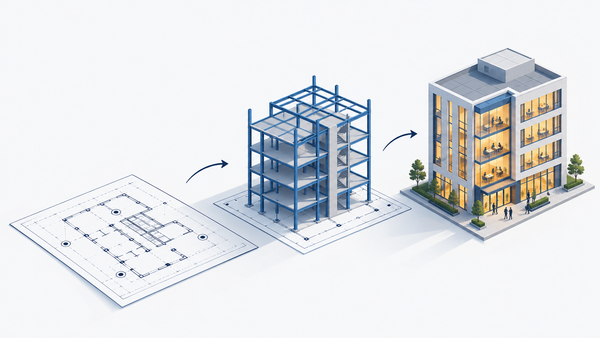
Do the Job Before You Lead the People Doing It
There was no team, just a job to do
When I started building the UK MSSP business at Fortinet, there was no team to lead - there was a job to do, and for a while I was the only one doing it.
It started in 2014, when David Park joined as UK Channel Director with a clear channel growth strategy that meant expanding the different routes to market, which coincided with an idea I pitched him: MSSP, the "channel of the future", as we would sometimes joke (albeit with a serious undertone). I'd have to spread myself far and wide, serve a small, almost negligible MSP and MSSP business far better than it was being served, and work with a lot more partners against a real go-to-market plan.
I recognised early that I'd hit a breaking point, and I suggested to him... when I did, we'd need to hire more people to share the load.
David backed me because I could show how it would benefit Fortinet, not just the partners. He gave me the freedom to build a plan focused on MSP and MSSP accounts, guided my thinking, and kept me focused on what would move the dial - Focus wasn't my strongest point back then. In 2019, when the time was right, he promoted me to build a dedicated MSSP team, and the business unit I went on to manage is still a key part of the Fortinet UK structure today.
David, still a friend and mentor, gave me support, coaching and creative freedom in those early years that was critical to my career, and I don't think I'd have achieved what I did if he hadn't joined.
It was the same story at TeamViewer... the front line first, the team after.
Accountable for everything
Building from zero, you lean on a virtual team across sales, SEs, marketing, operations and finance, although for a period you are accountable for everything. That means knowing the detail of every stage, from the first partner conversation through onboarding and enablement to the renewal coming round, and where cutting a corner today buys you pain down the line.
Matthew McConaughey described it on The Diary of a CEO as buying red lights - take the shortcut now and you've simply bought yourself a red light further down the road. It's the same principle I keep coming back to on services... there's an order to building something that works, and teams are no different.
Where I only partly agree with Steve Jobs
Steve Jobs said in 1985 that Apple's early professional managers didn't work out - "They knew how to manage, but they didn't know how to do anything" - and that the best managers are great individual contributors who never wanted the job.
I only partly agree. I've been very fortunate to work with plenty of great leaders who built teams without starting out doing the job themselves, although what they all had was a fundamental understanding of the requirements of the team, the customer and the partner, plus a willingness to get close to the action... they never managed it from a distance.
Contrary to Jobs' opinion, the star performer who takes the job because nobody else can do it as well can also make the worst manager, because they struggle to let go (more on that in Part 2), can't give context and freedom at the same time, and micromanage because they're convinced they could do it better than the person they hired.
Why doing it first helps form a good leader for the team
Doing the job first gives you three things you can't get any other way:
- ✅ Sharpness - you stay close to the work, the partner and the customer
- ✅ Clarity - you know what the role really needs, so the targets and process come from reality, not theory
- ✅ Credibility - when the team hits the wall, they know you've hit it too
Credibility is the foundation for everything else - you hire better, coach better and manage better when you know which corners can't be cut, because you've already paid for cutting them.
One caveat: I'm mainly talking about small, specialist teams inside a larger organisation, the kind that aren't necessarily understood yet. You need time to prove the model and turn gut feel into leading indicators, then pipeline and revenue. That takes more than the person doing the job - it takes an exec sponsor who provides the air cover and support, and a first follower to turn the lone nut into a leader. David was my exec sponsor.
Have you worked for someone who'd done your job before you, and did it change how you followed them? Or have you been the one on the front line, forging the new path - and did you have an exec sponsor giving you the air cover and time to build?
Next time: who was my first follower and who did I pass the baton to? And remember that breaking point I warned David about - how do you know you've reached it, and when do you step back to pass the baton?
Do It. Build It. Pass It On.
Written by
What's Next?

Welcome to Drop the Hype
Welcome. Let’s get back to basics. Hype is good and we need it. Let’s get that out of the way first. Hype creates awareness, unlocks budgets, builds business cases and gets people excited about what’s coming next. Without it, nobody’s buying and nobody’s building. Every wave - Cloud, SD-WAN, Zero Trust, SASE, DEX, AI and on... started with hype, and that’s exactly how it should be. However, hype doesn’t standardise, it doesn’t scale, and it definitely doesn’t make you repeatable profit. This