Strategy, Structure, People. In That Order.
Same company. Same product. One team grew more than twice as fast as the rest.
Between 2013 and 2021, the UK MSSP business I helped build at Fortinet averaged 55% revenue CAGR. Comparable regions, running a less structured go-to-market, averaged 21%, close to the roughly 23% the company grew overall. Market maturity, partner base and leadership all played a part, and I won't pretend otherwise... but in my experience, the biggest difference was the order we made our decisions in.
I started as an individual contributor on the front line, working the accounts, learning the partners, finding out where the systems got in the way and what actually wins. Only then did I define the strategy, then the structure, and only then go looking for the people to fit them.
That sequence isn't new. Alfred Chandler, the Harvard business historian, studied how DuPont, General Motors, Standard Oil and Sears grew in the early 20th century. Each one hit a wall when its old structure couldn't carry a new strategy, and only moved forward once it redesigned itself around that strategy. His conclusion has held for more than 60 years:
"Unless structure follows strategy, inefficiency results."
Alfred Chandler, Strategy and Structure (1962)
What gets said less often is how much each step shapes the next, so a wrong call at the start follows you through everything after it.
What "less structured" looked like
- Opportunity-driven rather than account-driven, chasing whatever turned up instead of targeting segmented accounts and building partnerships with the ones we actually wanted.
- Reporting lines and account ownership out of step, with compensation and quotas rewarding the wrong behaviour.
- A value proposition that didn't line up with the ICP or the ideal partner profile.
None of that is a people problem. It's individual-led decision making - rash calls, structures bent around whoever is in the room, strategy pivoting to suit a person rather than the market. Each one chips away at clarity, focus and execution.
Michael Porter, the Harvard strategy professor, makes a related point, explained well by Joan Magretta in Understanding Michael Porter. Keeping a strategy consistent over time gives people across an organisation the chance to understand it and see where their own work fits. Pivot the strategy to suit a person and you take that away.
The research on management points the same way. Nicholas Bloom, Erik Brynjolfsson, John Van Reenen and colleagues at the US Census Bureau surveyed tens of thousands of US manufacturing plants and found about 40% of the variation in management practices sat between plants inside the same firm. Same company, very different ways of running the team. In a separate randomised experiment, Nicholas Bloom and David McKenzie of the World Bank, with colleagues, gave free management consulting to Indian textile firms. The plants that adopted structured practices lifted productivity by 17% in the first year.
Here's the test I use. When someone asks to change the plan, ask what changed - the market, the evidence, the approach or the person? The first three are adaptation. The fourth is accommodation.
None of this means people matter less. Hiring great people with transferable skills works brilliantly when they step into clarity, structure and purpose, because it gives them a foundation to adapt from. My new hires joined a team with momentum from day one, and I coached them hard from there.
I've since applied the same approach with global system integrators at TeamViewer - targeted segmentation, time on the front line, and hiring people who fit a defined operating model, in a far more condensed timeframe.
Get the order right…
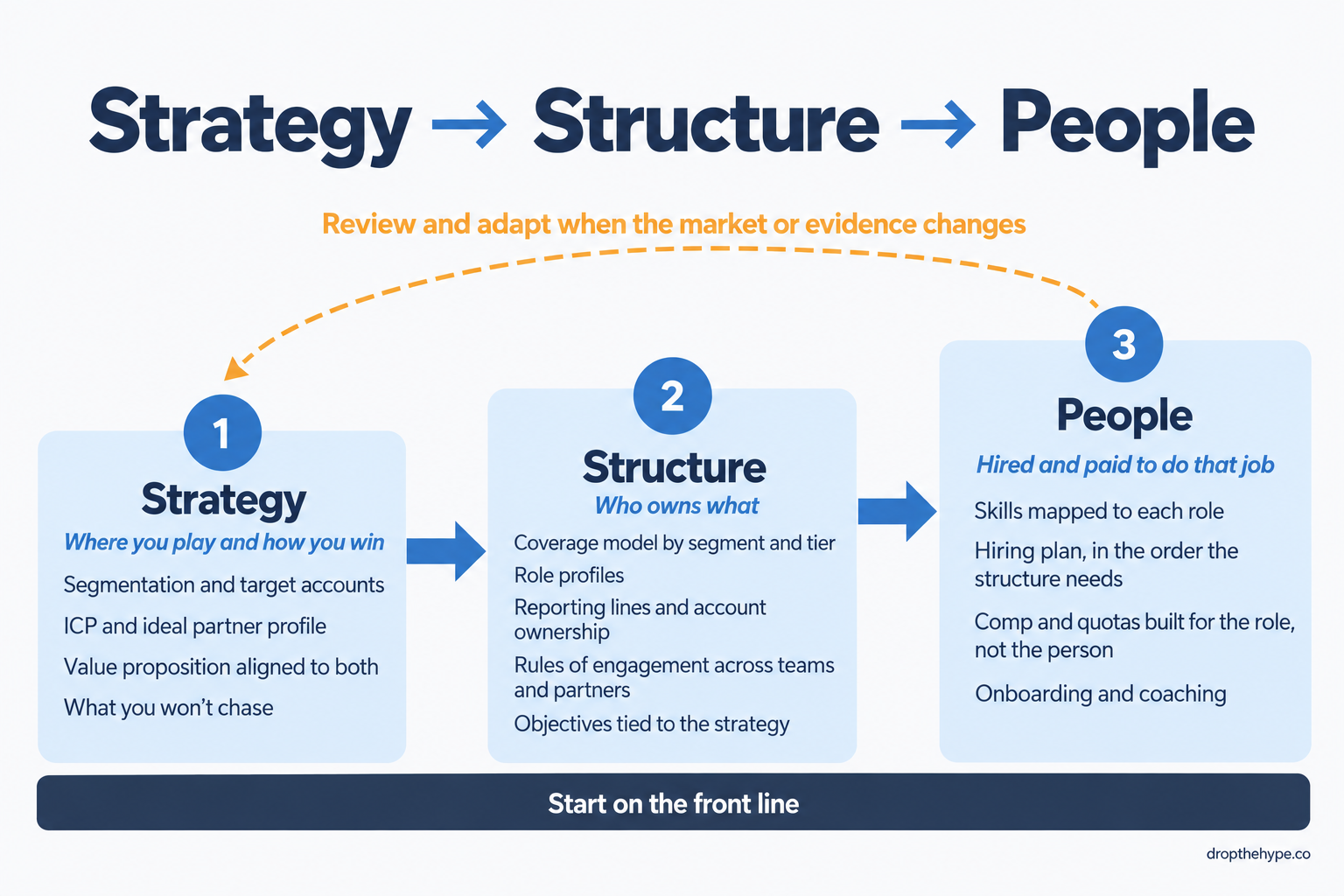
Strategy decides where you play and how you win. Structure turns that into roles, ownership and objectives. People bring it to life, hired and paid to do the job the structure describes. Ground all three in time on the front line, then review and adapt constantly, because the market will move even if you don't.
SSP isn't the only path to success, and a hot market can carry a messy team for a while. In the same company, chasing the same opportunity, the team that gets the order right is the one more likely to win, and to keep winning when the tide goes out. Get the foundation right and good people do the rest.
Look at your own team, function or region. Did the strategy shape the structure and the hiring, or did the people shape the strategy?
Strategy. Structure. People.
Written by
What's Next?

Do the Job Before You Lead the People Doing It
There was no team, just a job to do When I started building the UK MSSP business at Fortinet, there was no team to lead - there was a job to do, and for a while I was the only one doing it. It started in 2014, when David Park joined as UK Channel Director with a clear channel growth strategy that meant expanding the different routes to market, which coincided with an idea I pitched him: MSSP, the "channel of the future", as we would sometimes joke (albeit with a serious undertone). I'd have to