
It's Time Channel Programmes Enabled the Service, Not Just the Partner
Part 1 of 2. Partner enablement equips a partner to sell. Service enablement builds on it, and even your best partners will want it.

In Doughnuts and Beers, I wrote that relationships still get a partner manager into the room, though they rarely give the partner manager anything worth saying once they're there. What the vendor puts behind that partner manager affects whether the door stays open, and even your best partners will want service enablement, if you have it to offer.
Partner enablement and service enablement
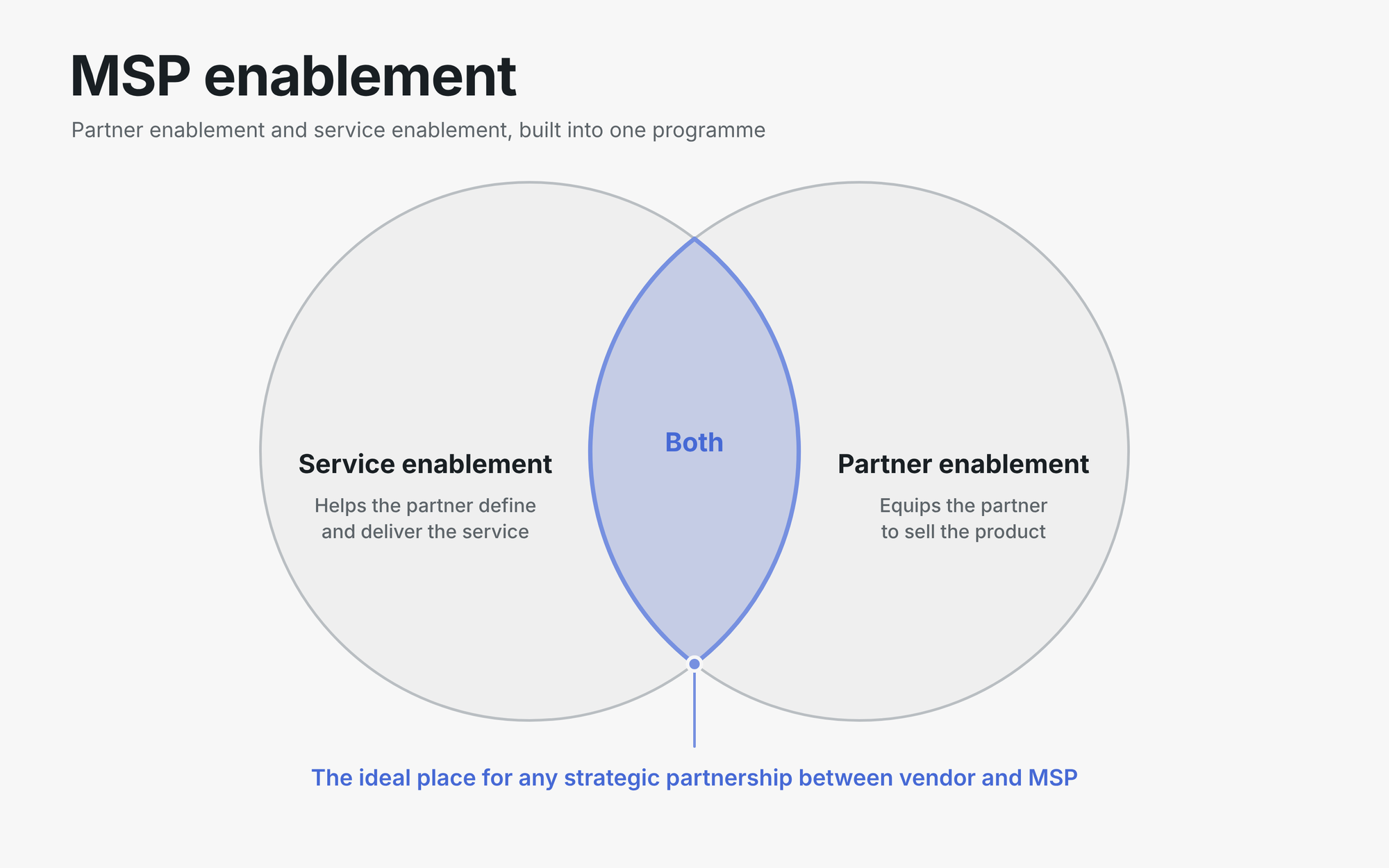
Partner enablement is the channel machinery, the tiers, certifications, onboarding, rebates, market development funds and training that equip a partner to sell the product. A lot more vendors are getting better at doing it for MSP partners, and it's essential to successfully grow through an MSP channel.
It's encouraging to see more vendors treat MSPs as a channel motion in their own right, with a managed services track inside one programme rather than a scheme on the side. You can see it across security, infrastructure, devices and networking. That's a real step forward for MSP partner enablement, and it leaves an even bigger opportunity: building service enablement into the same programme. In my experience, few programmes go as far as helping the partner define the service itself.
Service enablement starts from a different place. It assumes the partner isn't reselling a product, it's running a managed service for a defined customer, and it needs help bridging the gap between that service and the vendor's technology.
The ideal place for any strategic partnership between vendor and MSP is a channel model that leverages both.
When a top-tier partner asked for more
One example stays with me from 2024. I ran a breakout session on service creation best practice at an international partner event, and the first people to ask for time afterwards were the managing director and chief operating officer of a South African MSSP.
This is one of the most accredited partners in EMEA, and possibly globally. They are a top-tier MSSP, service partner and specialist partner, with a broad base of happy customers. The business is profitable, although they know it can always be better.
What was costing them time and money was that they didn't feel their value proposition was clear enough, internally as well as externally. The team are brilliant, honest, humble, super smart and very technical, and it helped to have someone from outside the business help them step back.
They wanted help bridging the gap between their service and the vendor's technology, and a go-to-market proposition built on what their service delivered rather than the product inside it. They also wanted to keep resource-intensive work for their upper tiers and project work.
We started remotely, with a structured engagement across 22 of their stakeholders to set a baseline of understanding about internal perception of the service proposition, then spent a day and an evening onsite with their senior leadership team in South Africa.
They'd already earned the accreditations, and none of what they were asking for would come from another certification or rebate... it needed work on the service itself.
The guardrails that hadn't been built into the contract
One of their biggest changes afterwards was building guardrails into the service, getting clear internally on the tasks and requests that drain time and money because they'd never been built into the contract from the outset.
The clearest example was policy customisation. Just because a customer was licensed for a capability didn't mean the MSP should be on the hook to customise it at no extra cost. The guardrail came in the form of a service deliverable specifically for policy customisation in an upper tier, and even that has guardrails of its own: typical applications and policies come from a library, while complicated custom ones may be reserved as a project.
It's a common problem across many MSPs, and the same pattern I wrote about in Five Signs Your Service Offer Needs a Refresh. It isn't always a known problem at the point of definition, it needs in-depth knowledge that often requires help from the vendor, and someone has to translate licensing and functionality into service deliverables and business value. That translation is exactly where service enablement earns its place.
With the guardrails in, they got time back, protected their margin and had a clearer conversation with their customers.
Profit isn't the only driver
Service enablement isn't just about helping a partner make more money. Partners don't always track profit down to a service line, and a lot of well-run partners are already highly profitable. Sometimes it's about laying strong foundations, getting to market quicker, improving cross-functional execution, competing harder in bids, chasing 1% gains or simply winning trust.
The goals are always different, nuanced and specific to the partner, though the job underneath is the same: bridging the gap between the service and the technology.
In Part 2, I'll look at why service enablement is harder than it looks. It takes the right vendor, the right people and the right timing, and I've positioned it too early more times than I would like to remember.
A vendor's MSP partner manager with a service mindset opens the door, but only a service enablement programme gives the partner something to keep the door open.
Does your channel programme enable the partner to deliver their service with your product, or just sell your product?
Until next time... partner like you mean it.
Written by