


Stop Calling It a Partnership If All You Want Is a Price

The word partnership gets thrown around more than any other in this industry. Most of the time it means nothing because what’s actually being asked for isn’t a partnership. It’s a better price.
Walk into any vendor QBR, any distributor pitch, any channel event and you’ll hear it everywhere. “Strategic partnership.” “Long-term partnership.” “We’re here to partner with you.” It sounds great. It means very little.
A deal is not a partnership. A deal is a transaction. It has a start date, an end date, and a number in the middle. Someone wins, someone loses, or if you’re lucky, both parties feel okay about it. Then it ends. Job done. Move on.
Partnership is something else entirely. It’s measured in years, not quarters. It requires investment — of time, of energy, of honesty — long before there’s anything to show for it. It asks both sides to show up even when the numbers aren’t there yet.
Trust. Collaboration. Commitment. Transparency. These don’t appear on a purchase order. They can’t be negotiated into a discount. You either build them deliberately or you don’t have them at all.
On one side: partnership — trust, collaboration, innovation, commitment, support, transparency, growth, and yes, price too. On the other side: just price. Price. Price. Price. All the way down.
That’s what it looks like when you make it all about the number. You get the number. Nothing else.
Price is always part of a real partnership — it has to be. Commercial reality doesn’t disappear just because the relationship is good. In a proper partnership, price is one element of something much bigger. Not the whole conversation. Not the ceiling and the floor.
When price becomes the only lever, you’re in a race to the bottom. Someone will always go cheaper. Someone will always undercut. When that happens, there’s nothing left to hold the relationship together — because there was no relationship. There was just a number.

I had a conversation a few years ago with a commercial director at one of the most acquisitive MSPs in their market. High growth, expanding fast, buying businesses left and right. They’d accumulated a significant footprint using our product across multiple entities — different contracts, different arrangements, all inherited through deals.
They said they wanted a partnership. I made the trip abroad to meet them.
The ask, when it came, was straightforward. Standardise the pricing across all their entities. Get everyone on the lowest rate. That was the starting point.
Fine. We could work with that — if we explored what a real partnership looked like - Broader use cases. Deeper engagement. Embedded in their service offerings. QBRs, targeted events, a proactive commercial relationship built around where they were heading, not just what they were already buying.
The response was no. Get the pricing sorted first. Everything else could wait.
They couldn’t (or wouldn’t) even commit to the idea of exploring a partnership until the price was fixed. Trust had to be earned — by us — before they’d put anything on the table themselves.
I appreciate the guy had a job to do. He had an agenda and objectives he needed to meet but he was unwilling to bring in other stakeholders to help us meet in the middle.
So I walked away. They got neither the pricing nor the partnership.
The irony is they could have had both. Had they leaned in — shown even a degree of openness to the bigger conversation — we’d have had something to build on. Instead, the only thing that mattered was the number. And that told me everything I needed to know about what kind of partner they’d actually be.
The vendors and MSPs I’ve seen build genuinely successful partnerships over time all share the same pattern. They got into the room before there was anything obvious to gain. They showed up when things were hard. They were honest when it wasn’t comfortable. They invested in understanding each other’s world — not just each other’s margin.
That’s not idealism. It’s commercial strategy. When the relationship is solid, price stops being the whole conversation. There’s something else on the table and that’s where the real opportunity lives.
Service before technology. Always.
Written by
What's Next?
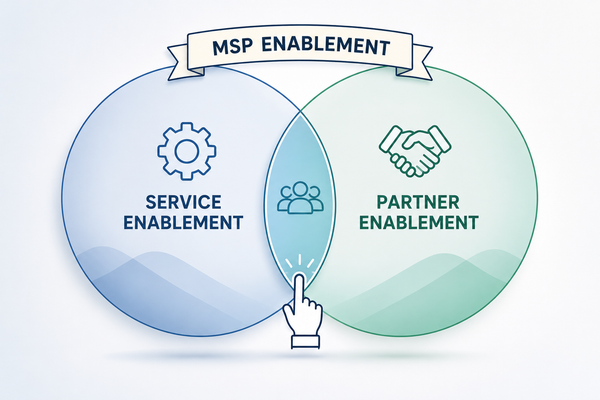
Service Enablement vs Partner Enablement
There’s a question I get asked a lot by vendor channel teams. “What’s the difference between Service Enablement and Partner Enablement?” It’s a fair question. The two get used interchangeably, often by people who haven’t really thought about it. They’re not the same. And the answer to which one a vendor should focus on is — both. Partner Enablement is the channel machinery Modular programs. Specialisation tracks. Onboarding. Discount structure. Rebates. MDF. Eval licenses. Training curriculum.
Five Signs Your Service Offer Needs a Refresh
In the last post I made the case for why legacy service refresh matters more than most MSPs give it credit for. Now let's get practical. Here are five signs that a service offer needs attention — and what to do about each one. 1. It lacks differentiation Strip away your logo and your brand colours. Does your service description look exactly like everyone else's? Generic high-level terminology. Vague value propositions. Nothing that tells the customer why this service, from you, is the one wo
Build the MSP Function the Next Decade Will Reward
The channel keeps asking whether the partner account manager is still relevant. It's the wrong question — and it's quietly letting vendors off the hook for the structural mistakes actually stifling their MSP growth. Every eighteen months or so, the channel rediscovers the same debate: is the partner account manager still relevant? It's a tidy, clickable question. It's also the wrong one. A yes/no answer to a multi-faceted domain misses the point entirely. Ask a closed question and you get a cl