


Build the MSP Function the Next Decade Will Reward

The channel keeps asking whether the partner account manager is still relevant. It's the wrong question — and it's quietly letting vendors off the hook for the structural mistakes actually stifling their MSP growth.
Every eighteen months or so, the channel rediscovers the same debate: is the partner account manager still relevant? It's a tidy, clickable question. It's also the wrong one.
A yes/no answer to a multi-faceted domain misses the point entirely. Ask a closed question and you get a closed answer — and neither tells you anything useful about why one vendor's MSP business compounds while another's stalls. The rep is rarely the variable that's broken. The structure built around them almost always is. And here's the uncomfortable bit: most vendors built that structure themselves.
Start with the principle most vendors skip
The vendors who genuinely win in this space share one trait. They treat MSPs — and every adjacent flavour, MSSP, GSI, hosting provider, the lot — as a partner-first motion, run out of the channel organisation. Not a direct deal with a partner logo stapled on. Not an enterprise account that happens to resell. A partner motion, owned by people whose job is partner economics.
Vendors who apply a different rule can still grow. They just grow slower, against more internal friction, and usually while wondering why the numbers never quite match the addressable opportunity. Partner-first isn't a slogan. It's a structural decision that determines where the rep sits, what they carry, and who they answer to.
Where it actually breaks
For MSPs specifically, most vendors get the structure wrong in three predictable ways.
They hire the MSP rep into the enterprise team. Wrong reporting line, wrong peer group, wrong incentives, wrong instincts. An enterprise team optimises for the big, named, single-customer pursuit. An MSP motion optimises for recurring volume across a partner's entire base. Drop one into the other and you've asked a fish to climb a tree, then blamed the fish.
They get the quota structure wrong. Most quotas are still built for sourced, transactional resell — the model the analysts keep telling us is dying, and they're right about that much. Bolt that quota onto a recurring, consumption-led, influence-heavy MSP motion and the maths simply doesn't describe the work. The rep chases the wrong outcomes because that's what the plan pays for.
They get the mix wrong. And the mix is the whole game. The right mix isn't a template you lift from the enterprise plan — it has to be derived, every time, from the opportunity flow, the sales motion, the MSP's own delivery model, and the end customer's buyer requirements and objectives. Skip that derivation and you'll ship a comp plan that fights the very motion it's meant to fuel.
The fault line nobody maps: single- vs multi-tenant
Here's the nuance that wrecks more MSP programmes than any other, because most vendors never even name it. Single-tenant and multi-tenant motions are not the same business, and they cannot run on the same rulebook.
A single-tenant motion behaves like a sophisticated resell — deal by deal, customer-owned, the partner delivering into one estate at a time. A multi-tenant motion is a platform play — the MSP owns the customer relationship, runs a shared stack, and monetises across many end customers at once. Account ownership, opportunity ownership, deal registration, quota credit: every one of those rules has to bend differently depending on which motion you're in.
Apply a single rulebook to both and you get two outcomes, neither good. Stifled growth, because the rules fit half the business and fight the other half. And internal conflict — the ugly, recurring kind. Who owns the account? Who owns the opportunity? Who takes the quota credit when the MSP's platform lands a customer the direct team also "knew"? That's not a personality clash. It's an unresolved structural question, showing up as a turf war.
So what is the modern rep actually for?
Once you've fixed the structure, the role sharpens into focus — and it looks nothing like the stereotype.
The old PAM — relationships, donuts and beers, a warm handshake and a golf day — is dead. Not dying. Dead. Relationships still matter, but they're table stakes now, not the skill. The skill that defines the modern channel rep is harder and far more valuable: the ability to reverse-engineer the customer requirement, run it back through the partner's value proposition, then map that onto the vendor's proposition — and adapt the entire approach to those variables.
Start at the customer's challenge and work backwards. Not "here's our product, who'll resell it," but "here's what the end customer is trying to achieve, here's how this partner uniquely delivers it, and here's where we fit inside that." Reps who can run that chain fluently are worth their weight. Reps who can't — the ones still leading with the product deck and the relationship — will die out. That much of the "is it still relevant" debate is true. But it's a skills problem dressed up as an existential one.
The role isn't going anywhere
The channel role itself will not die while the majority of global IT spend — Omdia estimates around 70% — keeps flowing through channel routes to market. You don't retire the function that touches most of the money. You professionalise it.
So park the closed question. "Is the PAM still relevant?" was never the point. The real one is quieter and far more uncomfortable: have you built a structure that lets a good MSP rep actually succeed — or have you dropped a partner-first motion into a direct-first machine and called the resulting mess a talent issue?
Most vendors haven't answered it. The ones who have are the ones compounding.
Written by
What's Next?
Service Enablement vs Partner Enablement
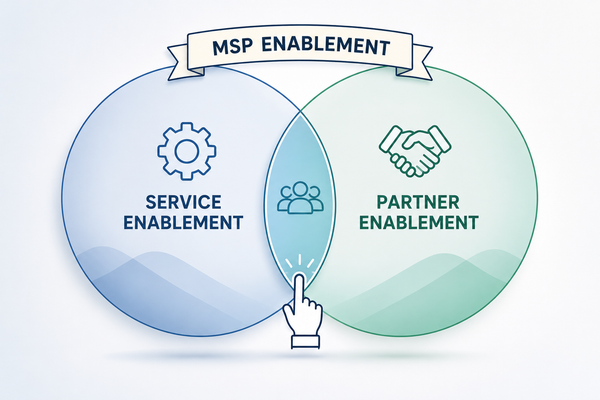
There’s a question I get asked a lot by vendor channel teams. “What’s the difference between Service Enablement and Partner Enablement?” It’s a fair question. The two get used interchangeably, often by people who haven’t really thought about it. They’re not the same. And the answer to which one a vendor should focus on is — both. Partner Enablement is the channel machinery Modular programs. Specialisation tracks. Onboarding. Discount structure. Rebates. MDF. Eval licenses. Training curriculum.
Service Enablement vs Partner Enablement
There’s a question I get asked a lot by vendor channel teams. “What’s the difference between Service Enablement and Partner Enablement?” It’s a fair question. The two get used interchangeably, often by people who haven’t really thought about it. They’re not the same. And the answer to which one a vendor should focus on is — both. Partner Enablement is the channel machinery Modular programs. Specialisation tracks. Onboarding. Discount structure. Rebates. MDF. Eval licenses. Training curriculum.